Selling expensive products sourced from China amplifies every logistical weakness. One damaged unit, one lost package, one missed inspection step and your margin on an entire batch can disappear in a single refund or negative review. The agent you choose becomes the operational layer that either protects or exposes your business.
A reliable partner for high-ticket dropshipping proves itself through four verifiable signals: documented pre-shipment inspection, protective packaging adapted to the product, traceable transit options matched to the destination, and transparent pricing with no hidden fees. These criteria can be tested before you commit significant volume, and this article walks through how to evaluate each one in practice.
Direct answer: A reliable China dropshipping agent for high-ticket products combines documented quality control with photo and video evidence, protective packaging designed for fragile or valuable goods, shipping options matched to product value and destination customs rules, and full transparency on costs and timelines. Validate these points with a paid test order before scaling.
What High-Ticket Products Really Require from a Dropshipping Agent?
High-ticket dropshipping does not simply mean selling more expensive items with the same workflow. The financial exposure per unit is multiplied, and so is the operational cost of each failure. A $15 phone accessory lost in transit is a nuisance; a $450 piece of equipment lost, damaged or mislabeled becomes a measurable hit to your cash flow and your store reputation.
Returns are a structural cost of e-commerce that any high-ticket seller should factor in. According to the NRF 2025 retail returns study, US retailers project 849.9 billion dollars in merchandise returns for 2025, equal to 15.8% of total sales, with online returns estimated at 19.3 %. On high-ticket items, each avoidable return driven by damage or mishandling has a disproportionate impact on your net margin.
Why generic agents fall short on valuable goods?
A generic agent is typically optimized for low-cost, high-volume items where occasional losses are absorbed by thin margins at scale. The usual pattern includes standard poly bags or thin cardboard, visual-only checks, limited photographic evidence and tracking that stops at the first-mile carrier. For a $20 product, this is acceptable. For a $300 product, each of these shortcuts becomes a potential loss event.
Working with a specialized China dropshipping agent that handles higher-value SKUs usually implies dedicated inspection stations, reinforced packaging workflows and tracked shipping as a default rather than an upsell. The gap is less about marketing claims and more about documented process maturity.
Risk categories specific to high-ticket transit
- Physical damage: impact, pressure or vibration during long-haul transit, aggravated by inadequate inner packaging.
- Loss and theft: higher resale value makes expensive items a target at sorting hubs and last-mile delivery.
- Quality inconsistency: supplier batches that vary in finish, materials or functionality, undetected without a proper inspection step.
- Customs delays and surprises: incorrect declared value or missing documentation can trigger inspections, duties or seizures.
Consider two scenarios for the same $350 product. With a generic agent, the item ships in a single-wall carton, no inspection photo, basic tracking. One in ten arrives damaged, triggering refunds, replacement shipments and negative reviews that depress conversion rates for weeks. With a specialized agent, each unit is inspected, photographed and double-boxed with corner protection, shipped on a tracked service. The per-unit cost is higher, but the return rate falls, and so does the hidden cost of handling complaints.
How Quality Control Protects Your Margin Before Dispatch
Quality control before dispatch is the single most leveraged step in high-ticket dropshipping. Catching a defect in the warehouse costs the price of a replacement unit; catching it after delivery costs the product, the return shipping, the refund, and often the customer relationship.

What a serious pre-shipment inspection covers
A documented inspection on a high-ticket item should go well beyond a visual check. Expect your agent to describe, in writing, a workflow that includes receipt from the supplier, verification against the order specifications, physical examination, functional test when applicable, and photo or video documentation attached to each shipment reference.
- Reception from supplierCount units, verify SKU references and compare against your purchase order.
- Visual inspectionCheck finish, color, assembly, labeling and absence of visible defects on each unit or on a defined sample.
- Functional checkWhere relevant, test switches, charging, moving parts or software behavior on a representative sample.
- Specification verificationConfirm materials, dimensions and declared features against supplier claims and your product page.
- DocumentationCapture photos or short videos, log serial numbers if relevant, and share the file with you before dispatch.
Packaging that matches the product value
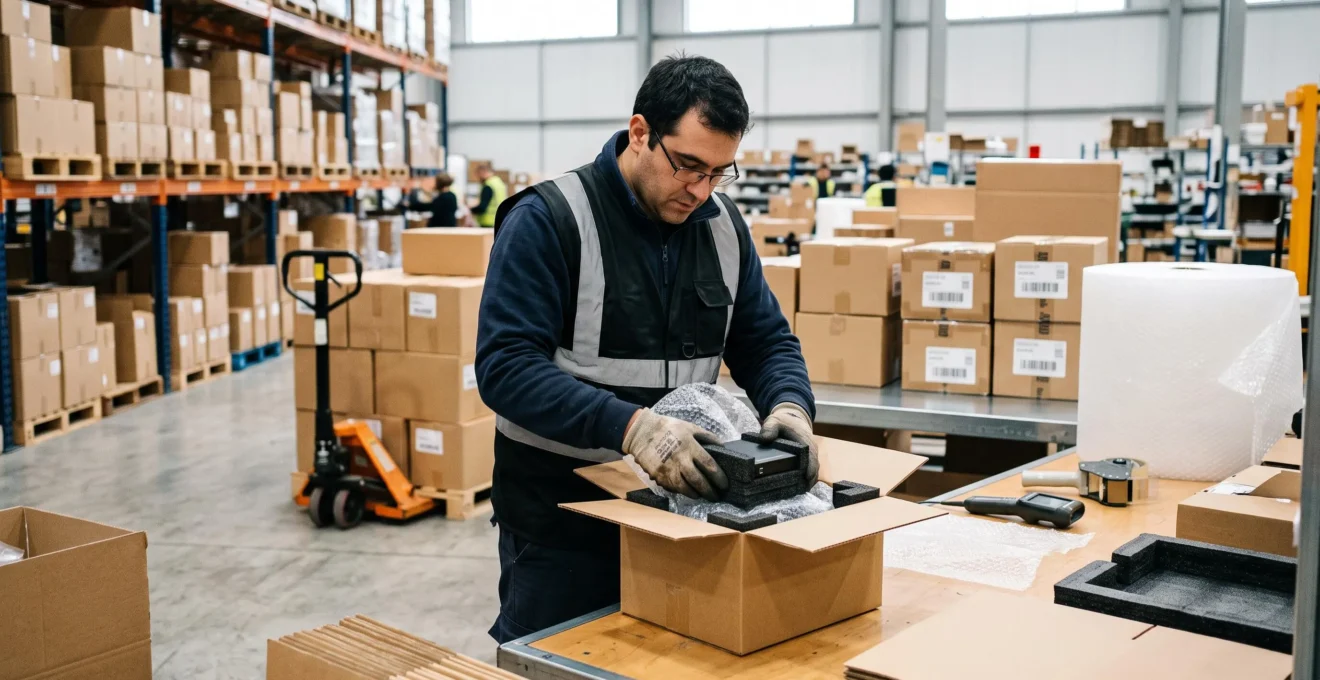
Packaging is where many agents cut corners silently. For a high-ticket product, inner protection is more important than the outer carton. A double-wall box, molded foam or cut-foam inserts, corner protectors and void fill reduce the probability of impact damage even when a parcel is roughly handled during sorting.
Custom branded packaging also plays a reassurance role on expensive products. A customer paying several hundred dollars expects an unboxing experience that signals care. Ask whether your agent can integrate branded sleeves, inserts or thank-you cards without compromising the protective layer.
Verify, do not assume: ask for photos of actual packaging used on past high-ticket orders, not generic marketing visuals. A real packing station tells you more than a brochure.
Choosing the Right Shipping Options for Fast and Safe Transit
Shipping is where the tension between speed, cost and safety becomes most visible. The right choice depends on product value, fragility, destination country and the customer promise displayed on your store. There is no universally best option; there is a best option per SKU and per market.
Comparing the main shipping tiers
Four broad tiers are commonly used from China: express courier, standard air, economy air or sea-air hybrid, and sea freight. The academic analysis of international transportation costs by David Hummels at Purdue University research on freight costs illustrates a long-standing pattern: air freight has historically cost roughly twice as much as ocean freight, reflecting a persistent trade-off between speed and price that still shapes modern e-commerce logistics.
| Criterion | Express courier | Standard air | Sea freight (bulk) |
|---|---|---|---|
| Typical use case | Urgent, high-value, low-volume | Regular high-ticket orders | Replenishing warehouse stock |
| Relative cost | High | Medium | Low per unit |
| Traceability | End-to-end, detailed | Good, carrier-dependent | Container-level, less granular at parcel level |
| Damage risk control | Fewer handling points | Moderate handling | More handling, longer transit |
For true dropshipping, where orders ship one by one from China to the end customer, express and standard air dominate. Sea freight becomes relevant only when you move to a hybrid model with local stock.
Customs, declared value and insurance
High-ticket items cross a threshold where customs becomes a real variable in your workflow. In the United States, imported goods must be formally declared on entry and may be examined by border authorities. The CBP customs value guide specifies that imported goods are declared to Customs and Border Protection and are subject to detention and examination, and that transportation and insurance costs are treated distinctly in valuation when properly documented.
Because duty thresholds, taxes and declaration rules differ by destination country, confirm two points with your agent for each market you serve: how the declared value is set on the customs invoice, and whether shipping insurance is included, optional or absent on the selected service. On a $400 item, the cost of insurance is usually marginal compared to the exposure if a parcel disappears.
Avoid under-declaration shortcuts: some agents suggest declaring a lower value to reduce duties for the customer. On high-ticket goods this is a regulatory risk and can void any insurance claim if a parcel is lost or damaged.
Evaluating Agents Against These Criteria Step by Step?
Vetting an agent is not a conversation, it is a process. The goal is to turn vague promises into verifiable evidence before you route meaningful volume. A structured sequence of questions, document requests and a paid test order is the practical way to filter candidates.
Questions to ask before you sign
- How is your pricing structured, and which fees are per-order, per-SKU or per-shipment?
- What exactly does your pre-shipment quality control cover, and can I see a sample inspection report?
- Which shipping carriers do you use for high-value items, and what is the typical transit time to my main markets?
- How do you handle a lost, damaged or defective shipment, and who absorbs the cost?
- How is inventory synchronized with my store, and how fast are stock updates reflected?
- Can you provide references or case examples with sellers in a similar product category?
The paid test order as a decision tool
A paid test order is the most honest filter available. Place a real order under normal conditions, pay the agent’s standard rate, and evaluate the end-to-end experience as a customer would. This exposes gaps that no sales deck can hide.
- Written specificationsShare product references, target markets, expected volume and your quality requirements; ask for a written proposal including fees and timelines.
- Process documentationRequest a sample inspection report, a packaging photo from a past high-ticket order, and the list of shipping services available for your markets.
- Paid test orderOrder one unit shipped to a real address under your own name, at the standard price and timeline, with no special treatment.
- Post-delivery reviewOpen the parcel on video, assess inner packaging, product quality, documentation, and compare transit time with what was promised.
- Edge-case simulationOpen a controlled dispute, for example a minor claim about an item, and observe response time, tone and resolution process.
- Written, itemized pricing with no vague « handling fees »
- Inspection reports with time-stamped photos or videos
- Clear policy on damage, loss and defective units
- Multiple carrier options with transit estimates per destination
- Real integrations with major e-commerce platforms
- Reluctance to share inspection evidence from past orders
- Vague answers on who pays when a parcel is lost or damaged
- Pressure to under-declare customs value
- Only one shipping option offered regardless of product value
- Slow or inconsistent replies during the sales phase
Key Takeaways and Next Steps
Reliability for high-ticket dropshipping is not an abstract quality. It is the sum of visible, testable practices: documented inspection with photo evidence, packaging adapted to the real value of the product, a shipping tier matched to destination and declared value, insurance where it makes sense, and transparent pricing from quote to invoice.
Decisive criteria for a high-ticket agent
- Pre-shipment inspection documented with photos or video
- Protective, product-appropriate packaging as a default
- Shipping options sized to product value and destination customs rules
- Clear accountability on lost, damaged or defective parcels
- Transparent, itemized pricing with no hidden fees
How do I protect fragile high-value products during transit from China?
Combine protective inner packaging (foam inserts, corner protectors, double-wall cartons) with a tracked air service and, when relevant, shipping insurance. Ask your agent for photos of actual packaging used on past high-ticket shipments rather than generic examples.
How do I test a dropshipping agent with a paid sample order?
Place a real order at standard price to a real address, with no special treatment. Review inner packaging, product quality, transit time and tracking accuracy, then simulate a minor dispute to observe how the agent handles claims.
What customs and insurance considerations apply to high-ticket dropshipped goods?
Confirm how the declared value is set on the customs invoice for each destination and whether insurance is included in the shipping service. Avoid under-declaration, which creates regulatory exposure and can invalidate insurance claims if a parcel is lost or damaged.
Which shipping option balances speed, cost and safety for expensive items?
For most high-ticket dropshipping, tracked express or standard air offers the best balance: fewer handling points than sea freight, better traceability, and transit times compatible with customer expectations. Sea freight becomes relevant when you move to a hybrid model with local stock.
The most useful next step is not another round of research. Shortlist two or three agents that already handle products in your value range, request a written proposal and an inspection sample, then place a paid test order with each one. The comparison between promise and delivery will tell you more than any sales conversation.